Sep 2025
What if my favourite painting was AI generated?
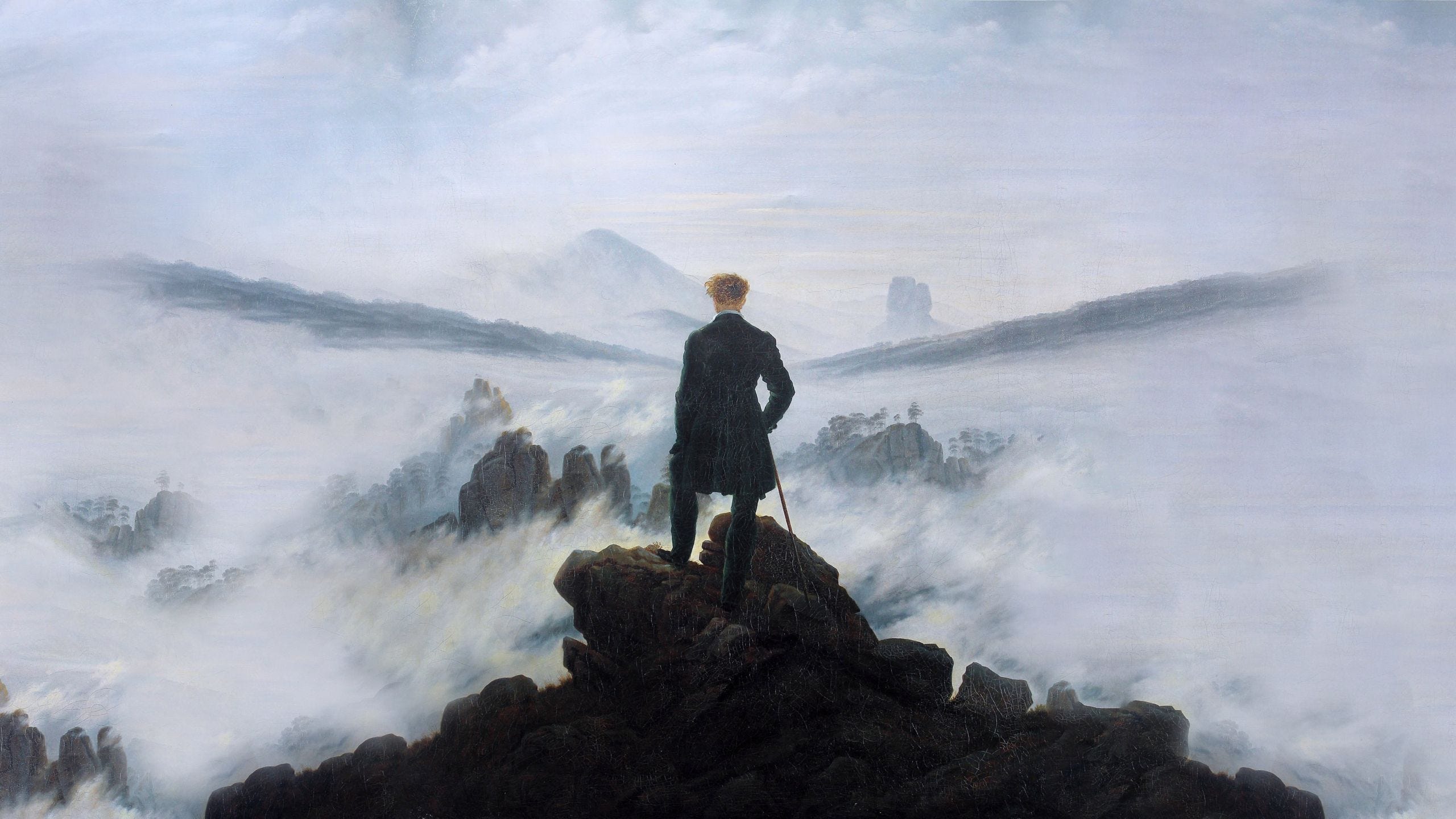
Finding Meaning in a Sea of Fog
I’ve always imagined myself as the Wanderer when looking at this painting; to me, this is the perfect image of what it feels like to think. I feel like I’m being beamed into Friedrich’s mind, and I can feel a connection between myself and the man standing at the edge of the world. I feel his tension as he stares into the unknown, and it mirrors my own.
I just finished my studies in California, quite far from my home in Delhi, and I’m now waiting for my work authorisation to get approved. I’m at the precipice of my future, and all I see ahead of me is uncertainty. When people ask how I’m feeling, I find that no combination of words feels as honest as this image.
The path forward felt even more tumultuous this week, as the president announced he’s making it harder to hire immigrants like me. So Friedrich’s masterpiece has become a space for me to think. It’s his invitation to step into a moment and share a deep uncertainty about what lies ahead.
This painting is more to me than just the sum of its brushstrokes. I feel a connection not just to the painting and its Wanderer but also to Friedrich. My comfort comes from knowing it’s a shared human feeling, captured by another person. It’s a feeling that transcends time, uniting me with him and with everyone who has ever seen themselves looking into the fog.
A Troubling Question
Any task a human can do, with the requisite training, an AI model can do better.
What if this painting, a work I connect with, was not the product of Friedrich’s consciousness, but of a dispassionate algorithm? How would I feel? Would the essence of my connection change? And if so, what does that reveal about the nature of authenticity itself?
The Uncanny Image
My gut reaction is to feel like I’m losing… something. The painting is still the same, the Wanderer is still looking into the fog, but the human-ness seems to be gone. I think that timeless, transcendent feeling is what’s missing. But I’m having trouble separating the art from the artist here, because my initial comfort came from knowing the person who painted this felt the way I’m feeling now.
But what if I didn’t know who made it? Would I still feel this way? And what if nobody knew, and we all felt this same connection, only to then find out a machine was the author? Would that diminish the painting’s power, or does the meaning come from the shared emotion it evokes in all of us, the viewers? This is, of course, a timeless question in art. Yet, the existence of a machine that can replicate Friedrich’s work makes the debate feel entirely new.
A Look in the Mirror
To answer that last and most important question, ‘Does meaning come from artistic intent or user interpretation?’ I think we need to have a closer look at the human creative process.
You and I are the sum of millions of years of evolution and our experiences. The way we think, the choices we make, the art we create—it’s all the product of everything we have ever encountered. My favourite way to demonstrate this is, “What’s the first colour that pops into your head after reading this question?”
For me, it’s red. But why? Why is it red and why isn’t it blue? The only answer I have is that, based on the entire history of my life leading up to this exact moment, it could not have been any other way.
In this way, maybe we aren’t so different from AI. Its output is determined by its training data and a prompt. My thought of “red” was determined by my life’s training data and the question. Perhaps neither of us ever really had a choice.
In the same way, Friedrich didn’t create in a vacuum. His inspiration could have been the real view from that cliff, a style inspired by another artist, or just a dream he had the night before.
The only difference seems to be transparency. An AI’s creativity can be reverse-engineered back to its dataset. A human’s is sourced from the ghost of an entire, unrepeatable life.
Embracing the Fog
When I look at the painting, do I care about what Friedrich wanted to say? Yes, in the beginning, I did. And I also must admit, an ‘AI-generated’ label would probably have prevented me from engaging with it in the way I have. But I imagine a different scenario. What if my parents had shown me this painting, and we had all shared a genuine connection to it, none of us knowing its origin?
If I later learned a machine was the creator, I don’t think it would change my feelings towards it. The painting would have moved beyond its original meaning and become something new: a vessel for our shared feelings and a tool for my own catharsis.